

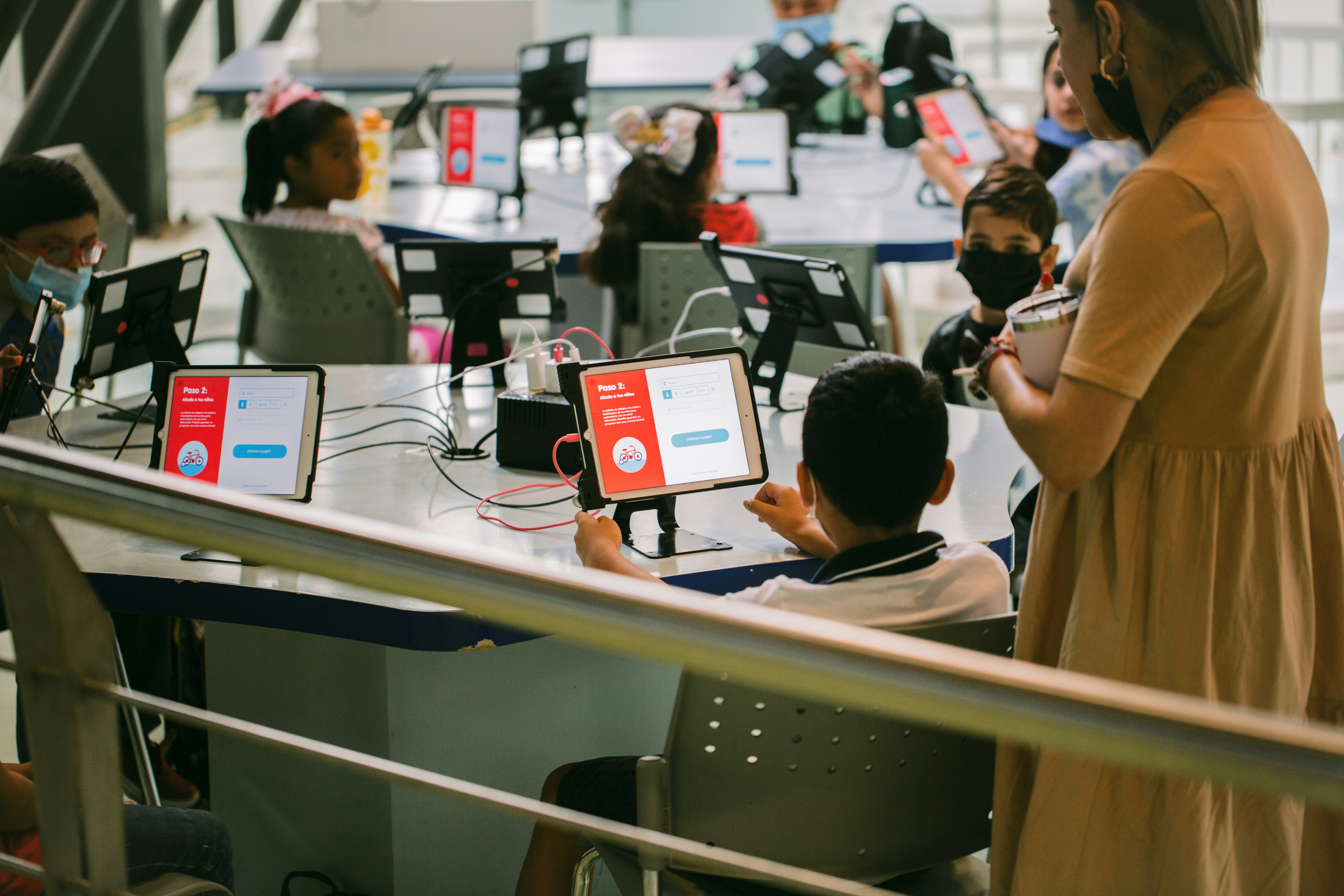
Technology has expanded learning beyond the fixed schedule and physical resources of the traditional classroom. Learning management systems organize lessons, assignments, discussions, and assessments in one accessible location, while digital textbooks can include searchable content, embedded links, audio, and interactive activities. Interactive whiteboards and video lessons help teachers present complex ideas through diagrams, demonstrations, simulations, and recorded explanations. Educational apps also provide practice opportunities that can be adjusted to different ages, subjects, and levels of readiness.
These tools support blended learning, in which face-to-face teaching is combined with online study, as well as remote education when learners and teachers cannot share a location. Virtual classrooms enable live instruction and discussion, while cloud-based documents allow students to collaborate on projects from different places and receive guidance during the process. Adaptive learning platforms analyze responses and alter the difficulty or sequence of activities, giving learners more personalized instruction. Immediate feedback can help students identify misunderstandings promptly rather than waiting for a later test or marking period.
The roles of teachers and students are changing alongside these resources. In a primary school, a teacher might use an interactive story or mathematics app to reinforce foundational skills, then observe progress and provide targeted support. In secondary education and higher education, students can research broader sources, create multimedia presentations, participate in virtual seminars, and manage parts of their own study schedules. Vocational learners may use simulations and video demonstrations to prepare for practical tasks, while adults can access flexible online courses that fit around employment and family responsibilities. Teachers increasingly serve as guides, facilitators, designers of learning experiences, and evaluators of understanding rather than simply delivering information.
However, effective classroom technology depends on purpose, accessibility, and sound pedagogy. A digital platform does not automatically improve learning, and an attractive application may distract from essential concepts. Educators must select tools that support clear objectives, encourage meaningful practice, protect student privacy, and complement strong teaching relationships. When used thoughtfully, technology broadens educational resources while preserving the teacher’s central role in helping learners interpret information, develop judgment, and apply knowledge.
Digital tools can strengthen educational quality by making instruction more adaptable, interactive, and responsive to individual needs. Teachers can combine videos, simulations, digital texts, quizzes, and collaborative platforms to present ideas in multiple ways. Adaptive software can adjust difficulty, pacing, and practice activities according to a learner’s progress, supporting students who need additional guidance while extending those ready for greater challenge. Translation systems and multilingual resources can help students learn across language differences, while culturally varied materials can make lessons more relevant to diverse backgrounds.
Technology can also make learning more accessible. Screen readers, captions, text-to-speech and speech-to-text tools, adjustable font sizes, contrast settings, and alternative input devices can reduce barriers for students with disabilities. Recorded lectures and searchable digital notes support learners who are absent, managing health conditions, or benefiting from repeated explanations. Online libraries, open educational resources, and low-cost courses extend learning beyond the classroom, particularly for people separated from schools by distance, work schedules, financial constraints, or limited mobility. These resources can support both formal education and lifelong learning.
Regular use of digital environments can develop skills that are valuable in education, employment, and civic life. Students learn to evaluate information sources, communicate online, collaborate on shared projects, solve problems, create digital content, and use technical tools responsibly. Teachers may share materials more efficiently, automate routine administrative work, monitor progress, and use learning data to refine lesson plans and provide faster feedback. Such capabilities can improve classroom time and allow educators to focus more closely on explanation, mentorship, and individual support.
The wider social impact includes greater participation in education and stronger preparation for changing labor markets. However, these benefits are not automatic. Reliable connectivity, suitable devices, accessible platforms, teacher training, privacy safeguards, and thoughtful public policy are essential. Without equitable access, technology may reinforce existing disadvantages rather than reduce them. Its educational value therefore depends on combining innovation with inclusive design, sustained support, and clear attention to the needs of learners and communities.
Over the next decade, education is likely to become more adaptive, connected, and flexible as emerging technologies mature. Artificial intelligence may support personalized tutoring by adjusting explanations, questions, and practice activities to individual needs. It can also assist teachers with formative assessment, language translation, lesson planning, accessibility tools, and the early identification of learning difficulties. These applications should be understood as decision-support systems, not replacements for educators. Teachers provide professional judgment, encouragement, context, and relationships that automated systems cannot reliably reproduce.
Immersive and interactive technologies could make difficult or abstract ideas more concrete. Virtual reality may allow learners to explore historical environments, scientific processes, or unfamiliar workplaces, while augmented reality can overlay useful information on physical objects and settings. Simulations, robotics, intelligent tutoring systems, and collaborative digital environments may support experimentation without the cost or risk of conventional equipment. Learning analytics and wearable devices could offer additional information about participation, progress, or accessibility needs, provided that their use remains proportionate, transparent, and respectful of privacy.
These developments may accelerate hybrid education, combining classroom instruction with online participation and independent study. Competency-based progression could allow students to advance when they demonstrate mastery rather than simply completing a fixed schedule. Micro-credentials, modular courses, and flexible delivery may also support continuous reskilling throughout working life. Future-ready curricula will therefore need to combine subject knowledge with media literacy, ethical technology use, coding where appropriate, creativity, emotional intelligence, civic responsibility, and adaptability.
Responsible innovation will depend on institutional preparation as much as technical capability. Teachers need sustained professional development and meaningful opportunities to shape implementation. Schools and universities should require transparent algorithms, strong data governance, interoperable systems, and research-based evaluation before adopting new platforms. Public policy must address affordability, connectivity, accessibility, and bias so that digital progress does not deepen existing inequalities. When guided by human values and evidence, technology can expand educational opportunity while preserving the central role of teachers and learners.
Educational technology can widen opportunity, but its benefits are not distributed equally. Students without reliable devices, broadband, electricity, technical support, or a quiet place to study may struggle to participate fully. These disadvantages can deepen achievement gaps, particularly when lessons, assignments, and assessments assume continuous connectivity. Accessibility barriers may also exclude learners with disabilities, while technology failures can interrupt teaching at critical moments. Schools therefore need dependable infrastructure, device and connectivity support, and meaningful offline alternatives rather than treating access as a private household responsibility.
Excessive screen use can create distraction, reduce concentration, and encourage shallow engagement. Automated tools may weaken persistence and independent problem-solving when students rely on them instead of developing knowledge and judgment. Heavy dependence on digital communication can also limit face-to-face interaction, handwriting practice, practical activities, and interpersonal relationships. Social isolation and constant exposure to online comparison may contribute to anxiety, reduced confidence, and emotional fatigue. Teachers must also manage additional platforms, technical problems, training demands, and administrative workloads.
Privacy and cybersecurity present serious ethical concerns. Educational platforms may collect student records, biometric information, behavioral data, location details, or usage patterns, sometimes through third-party services and targeted advertising systems. Data collected from minors requires particularly strong protection, clear consent practices, limited retention, and secure storage. Algorithmic bias can disadvantage particular groups, while inaccurate AI-generated information can mislead learners. Plagiarism, unauthorized assistance, surveillance, and opaque automated scoring make it difficult to determine whether assessments reflect authentic understanding.
Schools should adopt strong privacy laws, minimal-data principles, transparent procurement, secure systems, and regular impact assessments. Human oversight should govern automated decisions, and age-appropriate design should limit manipulative features. Digital well-being standards, media and AI literacy, accessibility testing, and clear academic-integrity guidance can help students use tools responsibly. A balanced model is essential: technology should complement, not replace, teachers, family support, physical learning, and human connection.